
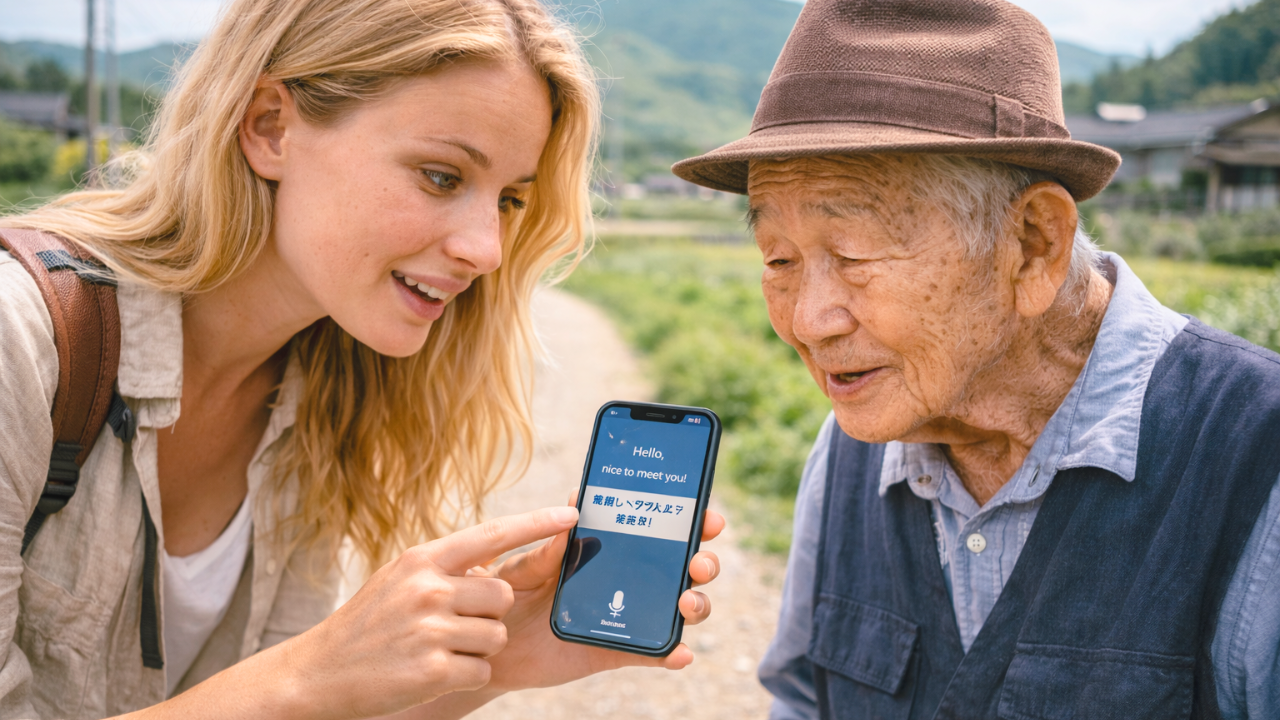
You don’t need to speak difficult Japanese to enjoy your trip.
If you remember just these five short and useful phrases, you can communicate in many everyday situations — at shops, tourist spots, and hotels.
Konnichiwa

(Basic daytime greeting / polite and friendly)
Use this when you start a conversation or meet someone during the day.
It gives a warm and respectful impression.
Arigatou

(Simple way to say “thank you”)
Say this whenever someone helps you or serves you.
With a smile, it makes your interaction friendlier and more positive.
Mata ne

(Casual “see you” / friendly goodbye)
A light, casual way to say goodbye to staff or friends.
It sounds friendly and relaxed.
Toire wa doko desu ka?

(“Where is the restroom?” / essential travel phrase)
Very useful in stations, malls, and public places.
If you point at a map or sign while asking, people will understand you more easily.

Fukuro wo kudasai

(“Please give me a bag” / for convenience stores)
In Japan, shopping bags are often not free.
Use this phrase at the counter when you need a plastic.
※This audio was generated using Ondoku-san.
Created By ondoku3.com
Start with these five phrases
Short phrases are easier to remember — and they work great in real situations.
With just these five expressions, your trip in Japan will already feel smoother and more enjoyable.
FAQ
Common Japanese phrases include basic greetings such as Konnichiwa (Hello), Ohayou gozaimasu (Good morning), and Konbanwa (Good evening).
Useful polite expressions are Arigatou gozaimasu (Thank you) and Sumimasen (Excuse me / Sorry).
For simple responses, Hai (Yes) and Iie (No) are helpful in everyday situations.
English is generally understood in major tourist areas such as Tokyo, Kyoto, Osaka, and Fukuoka.
However, in rural or local areas, English may not be spoken very much.
In those situations, using a translation app on your smartphone makes communication much easier.
Yes — in most cases it is not a problem.
At stations, airports, and tourist attractions, you will find English signs, announcements, and information.
You can also communicate using gestures, translation apps, photos, or maps, which usually works well.